Hello, everyone!
Living right out in the sticks, literally across from the jungle, you naturally become increasingly immersed in the authentic, everyday Thai way of life. Around here, you don’t just observe nature—you end up putting it on your dinner plate!
And today, I want to talk about one of our absolute favourite local treats: Red Ant Queen Salad, known locally as Miang Mod Daeng (เมี่ยงมดแดง).
When we head out into the bush to go ant egg collecting (which is a whole different adventure that deserves its own post later!), we don't just harvest the eggs. We also collect worker ants and queen ants. While the eggs are saved for a completely different dish, the actual ants and queens are used to whip up a highly popular salad that you can find all across Laos and the northeastern Isaan region of Thailand.
🥗 The Ingredients of the Wild
If you want to make a traditional Miang Mod Daeng, you don't need a complicated grocery list. You just need what you can forage and a few village kitchen staples.
Here is the traditional lineup:
The Stars: Crunchy red ants and the large ant queens.
The Greens: Finely sliced shallots, chopped lemongrass, and plenty of fiery bird's eye chillies.
The Seasoning: A splash of fish sauce (NamPla), salt, and a healthy dose of MSG (Ajinomoto) to bring it all together.
What makes this salad so incredible is the natural flavour of the ants themselves. They actually have a sharp, citrusy sourness (thanks to the formic acid they contain), which acts like natural lime juice in the dish!

🍃 How to Eat It: The Careya Sphaerica Leaf
We don't eat this salad with a spoon. Instead, it’s eaten as a Miang, which means everything is wrapped up into a neat little leaf bundle.

For this salad, we use fresh leaves from the Careya Sphaerica tree, known in Thai as Bai Gradon (ใบกระโดน). These leaves have a very distinct, slightly astringent and tart flavour.
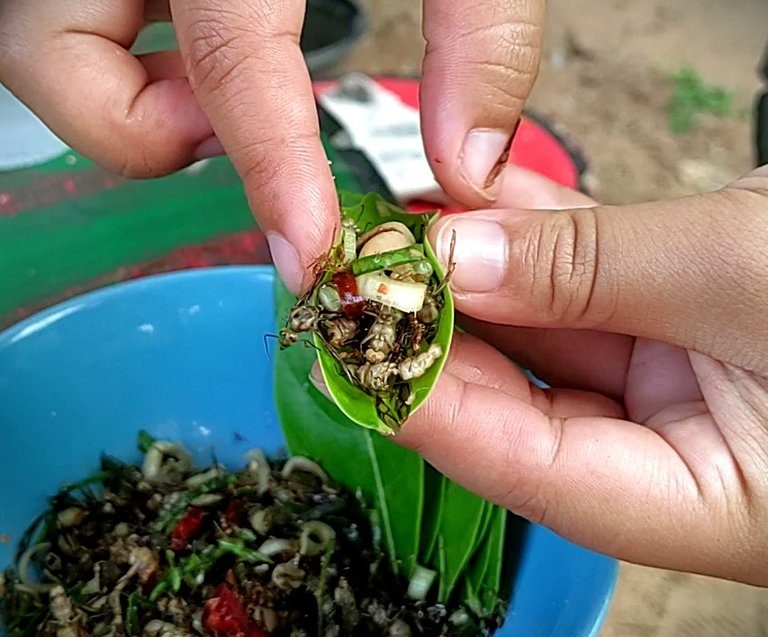

When you take a bite, the dry, tart crunch of the leaf cuts perfectly through the sharp sourness of the ants, the citrus notes of the lemongrass, and the explosive heat of the chillies. It is a massive blast of complex flavours in just one single bite!


💰 A Luxury Snack (If You Buy It!)
You might think that eating bugs is a "poor man's food," but in reality, this is far from a cheap treat. Whether you are buying ant eggs, worker ants, or the highly prized queens, they fetch a serious premium in the local markets. Prices usually start from 350 Baht per kilogram and can go way higher depending on the season and location.
Luckily for us, we don't buy them. If we ever get a craving for a wild, we just grab our gear, go right into the jungle, and harvest them ourselves. It is definitely not an easy job—those little red bastards bite hard and protect their nests fiercely—but the reward is absolutely worth the struggle!
Thanks for reading, and see you in the next chronicle of our real Thai village life!